
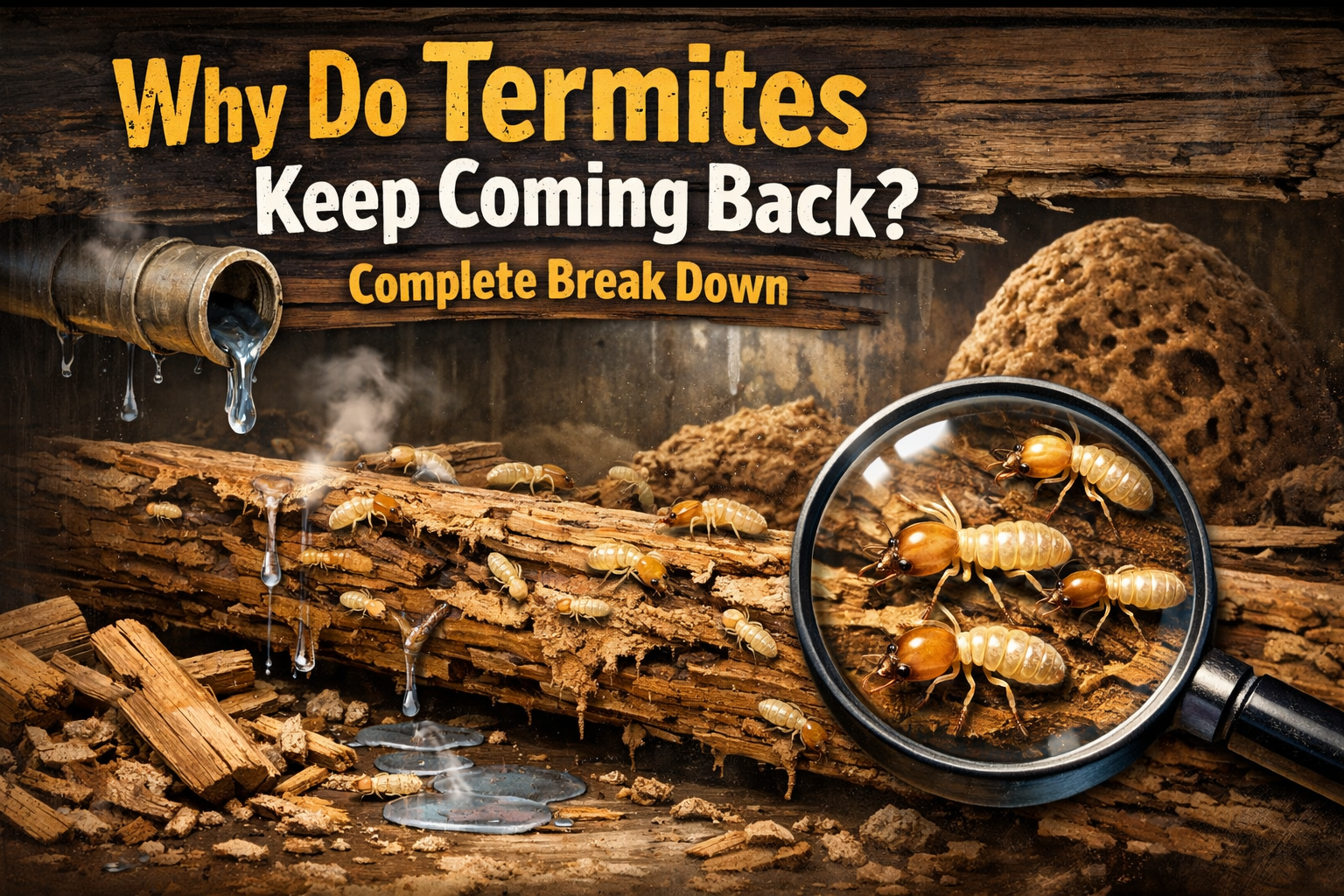
You treated your home for termites. For a few months, everything looked fine. No mud tubes, hollow wood & flying insects near the windows.
Then one day, you notice it again. A thin mud line creeping up the wall. A door frame that sounds hollow when tapped.
It is frustrating. You start wondering, didn’t we already fix this?
If termites keep coming back, there is always a reason. And most of the time, it is not random. Let us break down why do termites keep coming back to your home and what you can do to stop it permanently.
First, Understand How Termites Really Work
Termites do not just “visit” your house. They build colonies. A typical subterranean termite colony can contain thousands to millions of termites living underground.
When you see a few termites inside your home, that is just the worker group searching for food. The real colony, including the queen, is usually hidden in soil.
Here is the key:
Killing visible termites is not the same as eliminating the colony.
If the queen survives, the colony survives. And if the colony survives, termites will return.
1. The Original Treatment Was Incomplete
One of the most common reasons termites come back is incomplete anti-termite treatment.
Sometimes:
- Only affected areas were sprayed.
- The soil around the foundation was not fully treated.
- Drilling and injection were not done thoroughly.
- The chemical barrier had gaps.
Termites are persistent. If there is even a small untreated patch around your home, they will find it. That is why proper soil treatment for termites must be continuous and well-applied.
A rushed or low-cost job often leads to repeat problems.
2. The Chemical Barrier Broke Down
Professional termite control treatment creates a chemical barrier in the soil around your house. But that barrier does not last forever.
Several factors can weaken it:
- Heavy rain washing away chemicals
- Landscaping or construction disturbing treated soil
- Natural breakdown of termiticides over time
- Poor-quality products used initially
Most professional termite treatments last between 3 to 5 years, depending on soil type, climate, and chemical quality. If termites are returning after a few years, the barrier may need renewal.
3. Moisture Around Your Home Is Attracting Them
Termites love moisture. It is essential for their survival.
Common moisture sources include:
- Leaking pipes
- AC drainage dripping near walls
- Poor water drainage
- Damp bathrooms
- Water stagnation near foundation
- Roof leakage
Even if you had a strong termite prevention treatment done earlier, excess moisture makes your home attractive again.
Moist soil softens the treated zone and gives termites an easier path. Controlling moisture is one of the most important steps in long-term termite prevention.
4. Wood-to-Soil Contact Is Giving Them Direct Access
If wood touches soil directly, termites can bypass the chemical barrier entirely.
Examples:
- Wooden door frames touching ground
- Garden posts buried in soil
- Firewood stacked against walls
- Wooden furniture stored in damp basements
This type of setup invites a structural termite infestation.
Removing direct contact between wood and soil is a simple but powerful prevention step.
5. Nearby Untreated Properties
Many homeowners do not realize this.
Your neighbour’s house, a vacant plot, or even an old tree stump nearby can host an active termite colony. Termites travel underground and can easily migrate to your property.
Even if your home was treated properly, new termite colonies may form nearby and attempt entry again.
That is why annual termite inspection is strongly recommended, especially in high-risk areas.
6. DIY Termite Solutions Do Not Eliminate the Colony
Store-bought sprays may kill visible termites, but they rarely reach the source.
DIY methods usually:
- Kill surface termites only
- Fail to destroy the queen
- Do not create a continuous soil barrier
- Provide temporary relief
Professional pest control services use specialized termiticides and equipment that penetrate soil and reach hidden colonies.
If you relied on temporary solutions before, that may explain why termites keep coming back.
7. Cracks and Structural Gaps
Termites do not need a large opening. Even tiny cracks in the foundation are enough.
Entry points often include:
- Foundation cracks
- Gaps around plumbing lines
- Wall joints
- Expansion gaps
- Floor-wall junctions
Over time, buildings naturally develop small structural gaps. Without proper sealing and monitoring, these become entry routes for termites.
Are These the Same Termites or New Ones?
This is a common question.
If termites return within a few months after treatment, it is likely the same colony was not fully eliminated.
If they return after several years, it could be a new colony forming nearby.
Termites do not “remember” your house. They simply follow food sources and moisture. If your home provides both, they will attempt entry again.
How to Stop Termites from Coming Back for Good
Here is what works:
1. Full-Perimeter Professional Treatment
Ensure:
- Complete soil treatment around the foundation
- Proper drilling and chemical injection
- High-quality termiticides
- Written warranty
Quality matters more than cheap pricing.
2. Fix Moisture Issues Immediately
- Repair plumbing leaks
- Improve drainage systems
- Keep foundation area dry
- Ensure good ventilation
Dry conditions reduce termite survival chances significantly.
3. Schedule Regular Inspections
Even if you do not see termites, annual inspection helps detect early signs like mud tubes, wood damage, or swarmer’s.
Early detection prevents expensive structural repairs.
A thorough inspection, proper anti-termite soil treatment, moisture control, and routine monitoring can stop repeat infestations permanently.
If you are tired of seeing termites repeatedly, it is time to choose experts who focus on complete colony elimination, not temporary relief.
Deccan Pest Control provides professional termite control services in Hyderabad using advanced treatment methods, high-grade chemicals, and structured inspection processes. Our team ensures proper soil barrier application, long-lasting protection, and customer warranty support.
Do not wait until structural damage becomes expensive.
Contact Deccan Pest Control [9666648420] today for a detailed termite inspection and permanent solution. Protect your home before termites take control again.
FAQs
Termites usually return because the colony was not fully eliminated, the chemical barrier broke down, or moisture conditions attracted them again.
Professional termite treatment typically lasts 3 to 5 years, depending on soil type, climate, and treatment quality.
Yes, if the initial treatment was incomplete or if the colony survived. Immediate inspection is recommended.
No treatment is 100% permanent. However, proper soil treatment and regular inspections provide long-term protection.
Moisture, wood, cellulose materials, soil contact, and structural cracks attract termites.
Yes. Annual termite inspection helps detect early signs and prevents major structural damage.