
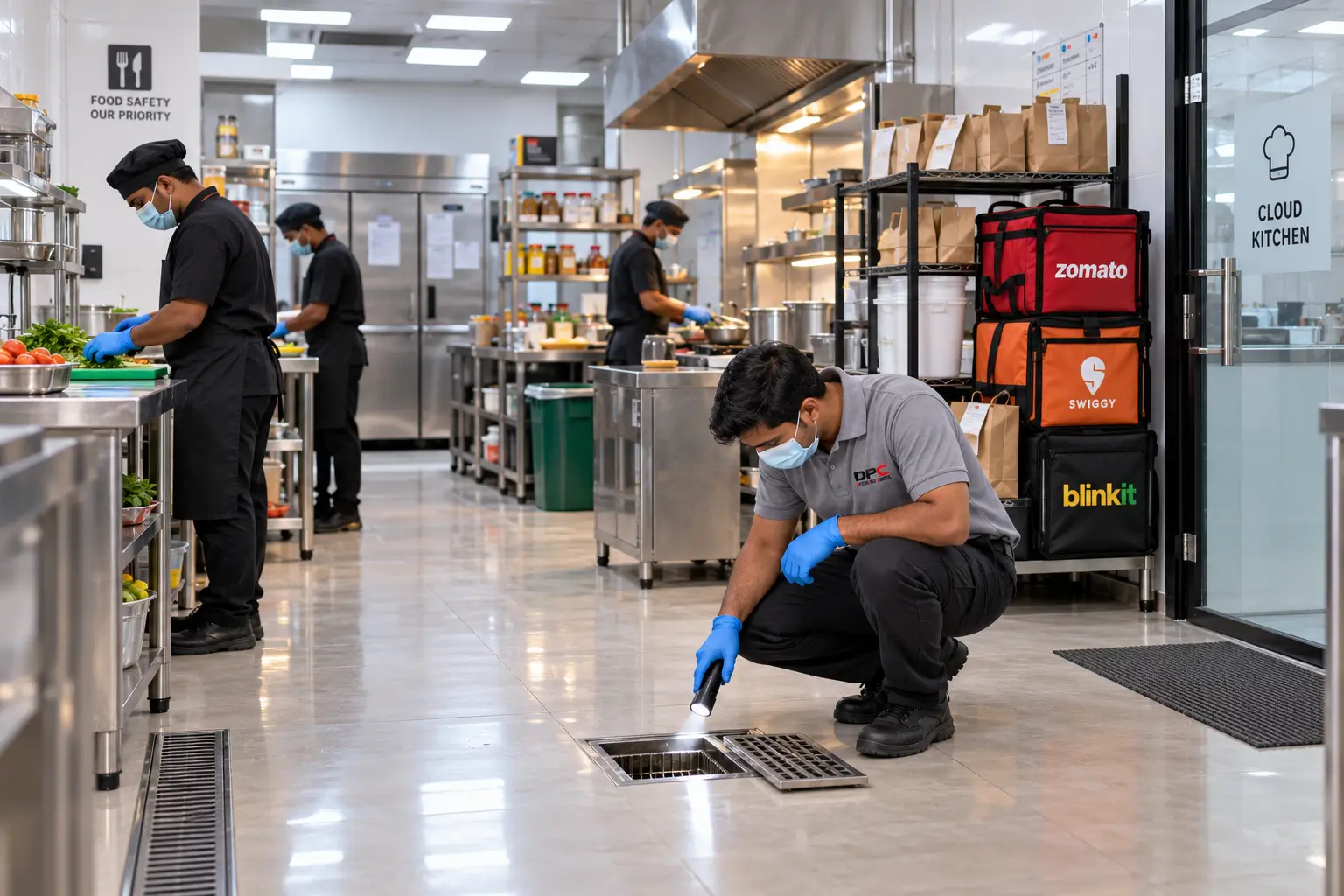
In short: FSSAI expects food businesses, including restaurants and cloud kitchens, to run a documented pest control programme through trained personnel, keep premises free of pests, and retain records for at least a year. Chemicals must not be sprayed while food is present. Schedule 4 sets no fixed frequency, so many Hyderabad kitchens choose monthly AMC service with a report after every visit.
Deccan Pest Control is a Hyderabad pest control company based at Mustafa Tower, Lakdikapool, serving all of Hyderabad and Secunderabad. We offer monthly AMC plans for homes and commercial kitchens, with 24/7 service.
Restaurant pest control in Hyderabad is no longer just housekeeping. One cockroach photographed by a customer, one rat seen by an inspector, or one missing pest control record on audit day can turn into a notice, a bad review or worse.
Food safety teams have been inspecting restaurants, cloud kitchens and central kitchens across the city, and pest activity and missing pest control records keep appearing in their findings. This guide explains what FSSAI expects, what inspectors look for, and how a regular programme keeps your kitchen inspection-ready.
Why are pests a licence and revenue risk for Hyderabad kitchens?
Because pest findings now affect your licence and your delivery-app listing, not just your reputation.
- Inspections are active. Recent inspections of Hyderabad eateries and cloud kitchens have flagged pest activity in freezers and kitchens, and in several cases noted that pest control records were not available.
- Serious infestations can cost a licence. A central kitchen supplying food brands in the Hyderabad region had its licence suspended after officials reported cockroach, housefly and rodent infestation along with other violations.
- Delivery platforms are paying attention. A Hyderabad cloud kitchen was removed from a food delivery app after an inspection found cockroach and housefly infestation. It was to be reconsidered only after licence renewal and a completed hygiene audit.
For a dine-in restaurant, the damage is to reputation. For a cloud kitchen that sells only through apps, being delisted can stop revenue overnight.
What does FSSAI expect on pest control?
FSSAI expects a documented pest control programme, run by trained and experienced people, with no signs of pest activity on the premises. These expectations come from Schedule 4 of the FSS licensing and registration regulations and FSSAI’s hygiene inspection checklist:
| FSSAI expectation | What it means in practice | Proof to keep |
|---|---|---|
| A pest control programme run by trained, experienced people | A regular, documented programme, not a one-off spray | AMC agreement, provider details and licence |
| No signs of pest activity | No live pests, droppings, eggs or larvae | Service notes and bait or trap check findings |
| Records kept for at least one year | A register plus a report from every visit | Pest control register, signed service reports |
| No spraying while food is present | Treat when closed or when food is covered and removed. Small food businesses should not spray during business hours | Service timings on each report |
| Insecticides stored away from food | Separate, labelled storage | Storage area, product list in the report |
Two more points:
- There is no fixed frequency. Schedule 4 does not say how often to do pest control. What matters is that your programme suits your kitchen and is documented. Many food businesses choose monthly.
- Your provider needs a licence. Commercial pest control operators work under the [Insecticides Act, 1968]. Ask to see their licence.
Registration vs licence: small food businesses holding only an FSSAI Registration follow a shorter rule set. The pest basics are the same: keep premises pest-free, do not spray during business, and store insecticides away from food.
This is a plain-language summary, not legal advice. For your exact obligations, check the current FSSAI regulations or ask your Food Safety Officer.
Which pests affect restaurants and cloud kitchens?
Cockroaches, houseflies, rodents, and ants or stored-product pests cause most of the problems.
- Cockroaches: the most common finding. They hide in cracks, behind equipment, in drains and in cardboard. See what attracts cockroaches in a kitchen.
- Houseflies: they come in with open doors, waste bins and drains, and inspectors spot them quickly.
- Rodents: they enter through gaps around pipes and doors and are drawn to dry stores and waste. See our rodent control service.
- Ants and stored-product pests: ants, weevils and flour beetles in grains, flour and spices.
Why do cloud kitchens face a different pest risk?
Cloud kitchens are compact, high-volume and usually inside shared commercial buildings, so pests can arrive from outside your own unit.
- Pests can travel in from neighbouring units, shared drains and common waste areas, so treating only your own unit may not be enough.
- Cardboard and packaging from constant deliveries are ideal cockroach hiding places.
- Tight storage leaves little gap between stock and walls, which makes cleaning and inspection harder.
- Many cloud kitchens run several brands from one kitchen, so one pest finding affects all of them.
- Because sales depend on delivery platforms, a failed inspection can mean delisting, not just a notice.
What should a pest control register include?
A register should record every service visit in enough detail that an inspector can see what was done, where and by whom. Include:
- Date and time of service
- Areas treated (kitchen, store, drains, waste area, dining)
- Pests targeted or found
- Treatment method and products used
- Provider and technician name
- Findings from bait stations and traps, if used
- Recommendations for you (for example, sealing a gap or fixing a drain)
- Signature of the technician and your representative
Keep these for at least a year and store them where you can produce them immediately.
What does an inspection-ready kitchen look like?
Check this list every month:
- A pest control programme is in place and documented
- It is run by a trained, licensed provider
- The latest service report is on file and the register is up to date
- No live pests, droppings, eggs or larvae in the kitchen or stores
- Doors, windows and vents are screened so pests cannot enter
- Gaps around pipes, drains and walls are sealed
- Food is in covered containers, off the floor and away from walls
- Waste bins are covered and emptied regularly
- Drains are clean and fitted with mesh
- Insecticides are stored away from food areas
- Treatments happen when the kitchen is closed or no food is exposed
How does a monthly pest control AMC work?
An Annual Maintenance Contract (AMC) turns pest control from a one-off emergency into a regular programme. Deccan’s commercial kitchen AMC plans include:
- Monthly visits to treat and monitor your kitchen, stores and drains
- A service report with every visit, ready to file in your register
- 24/7 service availability for urgent problems
A typical programme works like this:
- Inspection: a technician checks the kitchen, stores, drains and entry points and notes risk areas.
- Treatment plan: methods and products are chosen for your kitchen, scheduled for when the kitchen is closed or no food is exposed.
- Monthly treatment: targeted treatment of problem areas, with monitoring.
- Report: a written service report after each visit, with findings and recommendations.
- Follow-up: advice on sanitation and proofing, and urgent support between visits.
What do Deccan customers say about our service?

These reviews come from homeowners we serve. They show how we work and why customers renew.
“This is our 2nd renewal from Deccan Pest Control… They are simply good in terms of gel application, and the quality of the gel they apply is excellent… Overall good service and response.”
— Google review, home cockroach control customer
You can read all our reviews on our Google Business Profile.
What mistakes should you avoid?
- Spraying while food is out. It risks contamination and goes against FSSAI guidance.
- No records. Without a report or register entry, an inspector cannot see that treatment happened.
- DIY market sprays. They kill visible pests but often scatter cockroaches deeper into the building, and they leave nothing to show an inspector.
- Treating only the kitchen. Stores, drains, waste areas and shared spaces are common sources.
- Ignoring structural gaps. Treatment cannot keep pests out of a kitchen with open pipes and unscreened doors.
- Waiting for a problem. By the time customers or inspectors see pests, the infestation is established.
How do you choose a pest control provider for your kitchen?
Look for a licensed provider with food-premises experience, written reports and ongoing support:
- Licence: ask for their commercial pest control licence under the Insecticides Act.
- Trained technicians with experience in food premises
- A written service report after every visit
- A monthly AMC option so your programme is continuous and documented
- Round-the-clock support for urgent issues
- Clear advice on proofing and sanitation, not just spraying
Areas we serve
Deccan Pest Control serves restaurants, cafés and cloud kitchens across all of Hyderabad and Secunderabad. Our office is at Mustafa Tower, 4th Floor, near Krishna Children Hospital, Lakdikapool, Hyderabad 500004.
Get your kitchen inspection-ready
Deccan Pest Control helps Hyderabad restaurants, cafés and cloud kitchens stay compliant with monthly AMC plans, a service report with every visit and 24/7 support.
Book a free kitchen inspection: call +91-9666648420 or +91-9666665400, email info@deccanpestcontrol.com, or contact us here.
Frequently asked questions
FSSAI’s hygiene requirements expect licensed food businesses to run a pest control programme with trained personnel and keep records. In practice, a documented programme is essential for any restaurant or cloud kitchen.
Schedule 4 does not fix a frequency. Many kitchens choose monthly service, with extra visits if there is a known problem. The right schedule depends on your kitchen, location and pest pressure.
Yes. Cloud kitchens are food businesses inspected against the same hygiene standards, and shared buildings and constant deliveries make them especially exposed.
FSSAI guidance says not to spray chemicals while food is present, and smaller food businesses are advised against spraying during business hours. Schedule treatments for when the kitchen is closed or food is covered and removed.
Keep service reports and a register with dates, areas treated, products used, provider details and findings, for at least a year.
It depends on severity. Outcomes can include a notice with directions to fix the problem, a lower hygiene score and, in serious cases, licence suspension.